
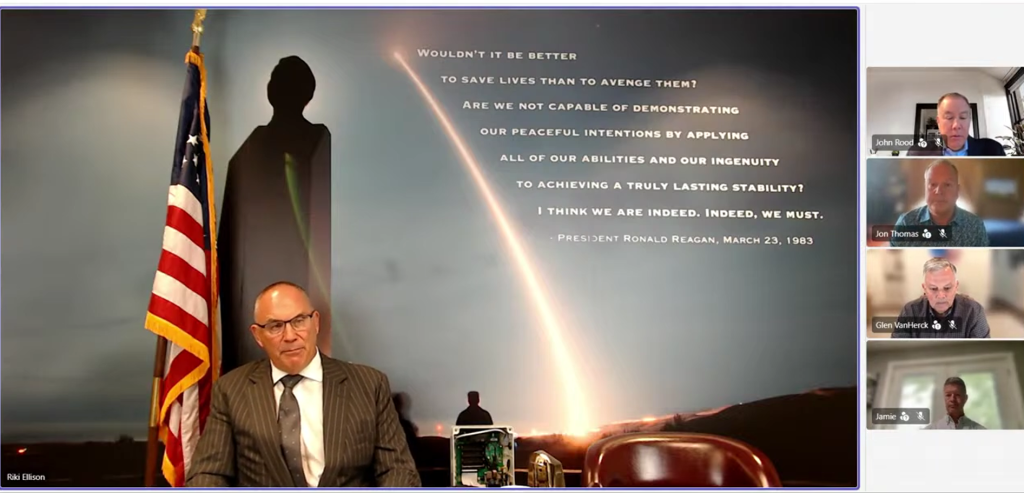
“Good morning, ladies and gentlemen. Welcome to another stunning spring day here in Washington, D.C. in Alexandria, Virginia. I’ve just come from the Pentagon this morning, meeting with A&S, and I just got back from a tour in the Middle East of our forward operating bases.
I’m Riki Ellison. I’m the founder and chairman of the Missile Defense Advocacy Alliance, an alliance that’s been built 20 years ago, and I have been involved with it for 40 years. Our sole mission is to make our nation and this world a safer place through the advocacy, deployment, and evolution of missile defense.
An organization, and the members that are going to speak today to you or with you are all on the same mission. We’re not a think tank. We’re not policy thinkers, and we’re a do tank, and we advocate for the warfighter, and no time ever in the history of missile defense is a time now that we have seen Iran exploit our gaps in this mission set, and it is humbling to see a great country like us not have those gaps resourced.
The culture and the process, those three fundamental things have to change for this mission set. This is our 98th congressional roundtable. It is who you’re going to call, and we have exceptional warfighters and policy fighters.
All of them are on the MDAA board, and they will be contributing to this discussion and advancing this discussion to educate, illuminate, and move forward with this. The facts are out there. You can look at Wall Street Journal, and you can look at videos, internet.
Our bases in the Middle East have been hit. They have been hit by drones. They have been hit by cruise missiles. They have been hit by ballistic missiles, and they have been hit by bombs. It has cost our country American blood. It has cost our country billions of dollars in radars, batteries, planes, and infrastructure.
Facts are the facts. We simply do not have the capacity, the capability, or the manpower to defend all of our bases in the Middle East. There are two solutions that we have to discuss, or we will try to discuss.
One, obviously, is the crisis of how we can do something now in the next few months or a few weeks to resolve this as much as we can. And then the bigger discussion on what is the strategic solution for base defense, for our country’s defense, against the multitude of these threats that we are seeing from Iran. But certainly, we have all watched for three years, every day, of what Russia has done to Ukraine.
We are no longer able to defend our bases from within our bases. That is a losing strategy. The evolution of this fight is what we watched in Ukraine.
You have to be outside the fence line. You have to be forward with capability and capacity, both to sense and both to take out. We have to be able to fight with our partners, with our allies, with our countries, and share C2. We have to have open C2 architecture to bring those assets in. We don’t do that. These are revolutionary changes that have to happen.
I’m going back now, because who are you going to call three years ago? Three years ago, right after the Ukraine war started in December, after that, a group of Ukrainians came to me with innovation to deal with the drone and ballistic missile and cruise missile threat. They created innovation that nobody’s ever seen before in terms of a cheap acoustic sensor, $600, and mobile fire trucks with machine guns and auto guns, but most importantly, a sky map and integration C2, where they’re bringing dirty data in to make it all together so they can be efficient with their shooting and being able to adapt it.
It was phenomenal. It’s been the baseline of them being able to defeat what we’ve seen Iran has done much greater than that with that. With that new innovation, I took the liberty as an advocate for what my mission said and brought it.
I brought it to EUCOM. I brought it to USAFE. I brought it to Glen when he was NORTHCOM Combatant Commander. I brought it to R&E. I brought it to SMDC. I brought it to A&S. I brought it to the biggest defense missile defense contractor in the world. I got it tested. They tested it in all of our bases, in INDOPACOM, across our country, and in Europe, and then with Tom Browning of R&E.
Then we got ghosted. It wasn’t made in the United States. We’ve got our pet projects.
It’s like John Boyd with the F-16 back in the day. They didn’t accept it, and they killed it. They put it in the Valley of Death where processes and risk adversity happens.
They didn’t address it. Every day, Shahed drones, cruise missiles, and Russian ballistic missiles were attacking, and the Ukrainians were defeating these. With Epic Fury, they got hit.
Who did they call? They went to their embedded folks in Ukraine, EUCOM, and US Army, 52nd & 10th AMDC, that are actually doing this. They brought them into the theater, and they are chasing the exact same systems that we advocated for three years ago.
It’s embarrassing, but we have to get a hold of this because it’s just going to get much bigger than what we’re seeing today. It’s like the IED problem, but it’s not an MRAP. You’re not going to get a silver bullet solution for this.
You’re going to have to get layers of capability out there, cheap mass, and you’re going to have to integrate it into your exotic capabilities that are there. I’m so glad that my board and I have the courage to address this. This has to be addressed.”
– Riki Ellison, 98th MDAA Virtual CRT
Executive Summary
I. Introduction
The Virtual Congressional Roundtable, “Who You Gonna Call?,” hosted by the Missile Defense Advocacy Alliance (MDAA), convened seasoned senior defense leaders and warfighters to address a critical and rapidly evolving threat: the vulnerability of U.S. military bases—particularly in the Middle East—to missile, drone, and air attacks. The discussion underscores an urgent need for reform in U.S. missile defense strategy, acquisition processes, institutions, and operational doctrine in light of recent attacks attributed to Iran and its proxies.
II. Core Problem
Participants emphasized U.S. forces currently lack sufficient capacity, capability, and integration to defend forward-deployed bases against modern threats, including drones, cruise missiles, and ballistic missiles. Despite years of warning signs—from conflicts in Ukraine to earlier regional attacks—the U.S. has failed to adapt at the necessary speed.
Recent attacks have resulted in:
- Loss of American lives
- Destruction of high-value assets (e.g., aircraft, infrastructure)
- Billions of dollars in damages
The consensus: the current approach to base defense is inadequate and unsustainable.
III. Key Drivers of Failure
1. Cultural and Institutional Barriers
- Resistance within the Department of War to prioritize missile defense due to cost and competing priorities
- Overreliance on legacy systems and traditional warfare assumptions (e.g., air superiority)
- Failure to internalize the shift to an age of “missile and drone warfare”
2. Acquisition and Process Limitations
- Slow, risk-averse acquisition cycles (often 10–15 years)
- A “Valley of Death” where innovative technologies fail to transition to deployment
- Lack of clear ownership across services for base defense missions
3. Resource Misalignment
- Insufficient funding and prioritization of air and missile defense systems
- Overinvestment in expensive offensive systems (e.g., fighter aircraft) versus scalable defensive solutions
- Lack of predictable demand signals for industry, limiting production scaling
4. Fragmented Command and Policy Structure
- Unclear roles between the Army and Air Force regarding base defense responsibilities
- Failure to establish unified command, control, and acquisition authority
- Limited integration with allies and partners
IV. Changing Nature of Warfare
The discussion highlights a fundamental shift in modern conflict:
- Low-cost, high-volume threats (drones, loitering munitions) are dominating battlefields
- Adversaries (Iran, Russia, China, & North Korea) are collaborating and adapting rapidly
- Traditional reliance on expensive interceptors and manned aviation is increasingly ineffective
Ukraine was cited as a leading example of innovation, demonstrating:
- Use of low-cost sensors and decentralized systems
- Rapid adaptation and integration of battlefield technologies
- Effective countermeasures against larger, more advanced adversaries
V. Immediate Risks
- U.S. bases remain highly vulnerable to continued attacks
- Current defenses rely on expensive, limited systems (e.g., air-to-air missiles) against cheap threats
- Lack of layered defense forces commanders into tradeoffs between protecting personnel and assets
- Similar vulnerabilities exist in the U.S. homeland, not just overseas
VI. Recommended Solutions
1. Immediate (Crisis Response)
- Rapid deployment of existing, proven, and scalable technologies
- Implementation of open-architecture command and control (C2) systems to integrate sensors and effectors
- Increased use of passive defenses (dispersion, deception, & mobility)
- Leveraging commercial and allied capabilities
2. Near-Term (6–12 Months)
- Field affordable, attritable, layered defense systems
- Accelerate acquisition by bypassing traditional processes where necessary
- Expand partnerships with innovative small and mid-sized companies
- Provide industry with clear demand signals and funding commitments
3. Long-Term (Strategic Reform)
- Establish clear ownership and accountability for base defense missions
- Reform acquisition systems to operate at the “speed of relevance”
- Develop a layered, integrated base defense architecture combining offense and defense
- Strengthen coalition-based defense systems with allies
- Align initiatives like Golden Dome with real-world operational needs
VII. Organizational and Structural Considerations
Participants debated multiple structural solutions:
- Assigning responsibility to a single service
- Creating a joint or independent organization
- Establishing a new unified command focused on integrated air and missile defense, automation, data, AI, forward base defense, and offense-defense integration
While opinions varied, there was agreement that status quo structures are insufficient and require reform.
VIII. Conclusion
The roundtable concluded with a clear and urgent message:
The United States is at a critical inflection point in missile and drone defense.
Failure to act will result in continued loss of life, strategic disadvantage, and erosion of deterrence. The technology to address these challenges already exists—the primary obstacles are culture, policy, prioritization, and execution speed.
The path forward requires:
- Immediate action
- Institutional change
- Sustained investment
- Integration across services, allies, and industry
Without these changes, the U.S. risks falling further behind in an era defined by rapid, low-cost, and highly adaptive threats.
Speakers:
General (Ret.) Glen VanHerck
Former Commander of NORTHCOM & NORAD
Lt. General (Ret.) John Thomas
Former Deputy Commander PACAF
Lt. General (Ret.) Jamie Jarrard
Deputy Commanding General USARPAC
Mr. John Rood
Former Under Secretary of Defense for Policy
Mr. Riki Ellison
Founder & Chairman, MDAA
Click here to view the full transcript