
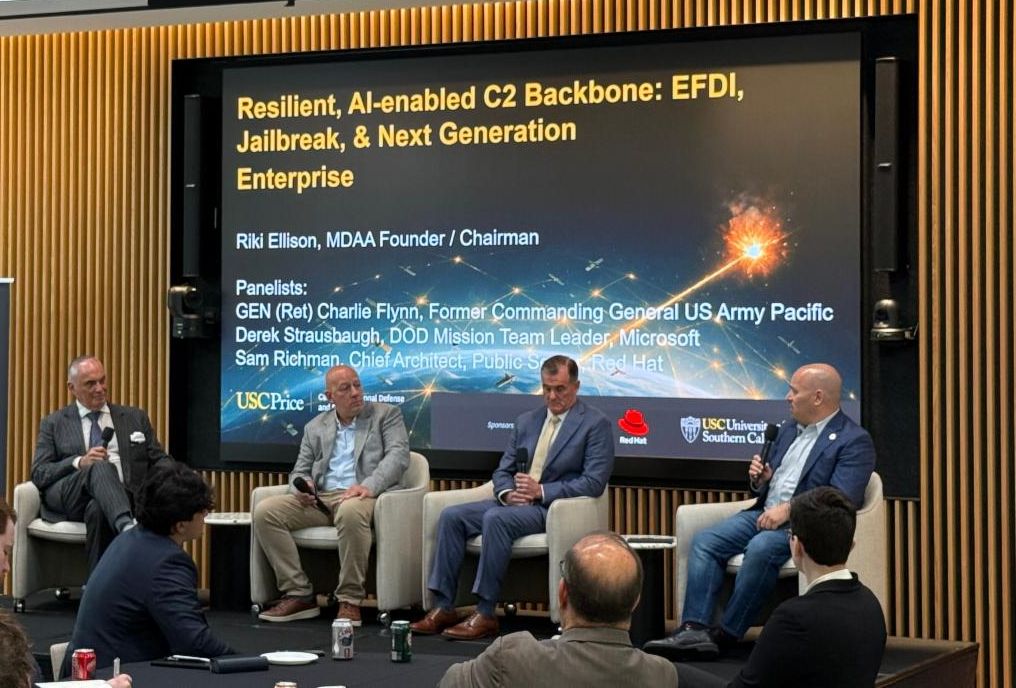
“My thanks to the University of Southern California, and to Frank Zerunyan in particular, for hosting us today. I’m grateful as well to Red Hat and the USC Price School for sponsoring this event.I want this to be a candid discussion. We have spent a great deal of time theorizing and debating technical solutions; today I want to be direct about what has actually happened, and about what we must do to reclaim our standing as the world’s leading power in this domain.
We have been exposed — by gaps in our defensive capabilities and by a failure to share data. Over two months of Epic Fury, the United States lost a minimum of twenty-five billion dollars. Twenty of our bases were struck by drones, cruise missiles, and ballistic missiles. Seven American soldiers are dead and more than 380 are wounded — because we, as a nation, did not plan properly or field the capabilities those bases needed to prevent such losses. We chose not to defend them. Under these circumstances, there is no pure atmosphere for peace.
I begin here deliberately, because we will frame today’s discussion around command and control first, and then turn to the responsibilities that follow from it. Together, we’ll work toward those solutions. Let me shift tone for a moment, because I always like to start with winners — and for me, that means starting with a championship defense. I’m a diehard. My mother went here, my son went here, and I came here on a football scholarship. As Frank mentioned, I was part of a couple of national championship teams — though I’ll be honest, I couldn’t keep up with the academic load on that track.
In 1980, as a sophomore, I transferred out of calculus and mathematics and into the strategic defense studies program at USC, led by Dr. William Van Cleave — a SALT-era arms negotiator working to break out of the ABM Treaty. Several of my lecturers were giants in the field, among them Edward Teller. For those who know Teller’s name: that program was, in the truest sense, the intellectual home of the Strategic Defense Initiative and of the case for breaking out of the ABM Treaty — a goal that took another twenty years to achieve.
The most important data came out around the time I graduated from USC. So I’m an original — forty-six years in this work, across eight presidents. I have seen it all. And whichever party is holding the ball, the fundamentals don’t change. They can call the play and they can put points on the board, but execution is what matters, and I’ve worked through all eight administrations up to the one we have today.
Missile defense has evolved considerably. As you know, it began with Ground-Based Interceptors and a limited ICBM defense — that is where we put our money and our focus, constrained by the ABM Treaty. In practice, we were instrumental in advancing that position. We were all over this.
Let me say this plainly: what lies ahead is bigger than anything we have ever attempted. The vision is about data — about the capacity to gather it from everywhere in the world and put it directly in the hands of our decision-makers.”
– Riki Ellison
Executive Summary: Convening against the backdrop of Golden Dome’s transition from concept to execution, panelists argued that the command-and-control backbone, not the interceptors or sensors, is the decisive layer that determines whether the architecture functions as a shield at all. They stressed that an enterprise fire-direction and data-integration capability is the precondition for fusing fires across services and domains, yet today’s stovepiped systems and combatant-command seams leave dangerous gaps in the sensor-to-shooter chain. Speakers were direct that the United States stands extremely vulnerable in ways the government appears to be downplaying: hypersonic and cruise threats compress decision windows below human reaction speed, while the C2 and AI-assurance layers that would close that gap remain underfunded relative to the more visible effectors and satellites.
The “jailbreak” discussion formed the Army’s intellectual core, with panelists warning that AI-enabled C2 introduces a new attack surface in which adversarial inputs, data poisoning, and spoofed tracks could manipulate the very decision systems meant to operate at machine speed. Several cautioned that fielding AI faster than it can be tested, verified, and certified risks embedding unexamined failure modes into homeland defense, and that human override becomes hollow if it cannot keep pace with automated engagements. On the next-generation enterprise, the panel pressed for open and modular architecture, on-orbit resilience to sustain the backbone after an attack, and coalition interoperability built in from the start rather than bolted on later. A recurring concern was governance: no single authority is clearly accountable for an enterprise spanning NORTHCOM, SPACECOM, MDA, SDA, and the services, leaving integration to fall through bureaucratic cracks. Panelists characterized the moment as a mismatch between political urgency and architectural reality, appropriations exist, but the detailed design, standards, and governance to execute them do not. The advocacy consensus was that resilient, assured, AI-enabled C2 is not a supporting feature but the program itself, and the layer most likely to be shortchanged in budget tradeoffs. Closing recommendations centered on protected funding lines for C2 and AI assurance, mandated open standards, a named enterprise-integration authority, and sustained test-and-evaluation investment. The overarching message: a collection of sensors and interceptors is not a shield until a survivable, open trustworthy backbone ties them together, and the window to build it correctly is narrowing.
Combat Is Writing the Requirements Now
Ellison opened by arguing that the United States is watching two wars — Ukraine and the Middle East — force a new kind of innovation in real time, and that the country has been too slow to absorb it. His central claim was that the problem is not technological but cultural: America has historically won its wars by tolerating risk and accepting repeated failure on the way to a breakthrough, and it has lost that appetite. Four years of battlefield innovation in Ukraine — much of it shared freely with the United States and NATO — went largely unapplied, leaving U.S. bases and forces exposed when the Middle East fight intensified.
He framed missile and drone defense as inseparable from passive defense and resilience, pointing to Israel’s civil-protection posture as a model for absorbing attacks the interceptors cannot fully stop. He also flagged a same-day policy development — a Department of War move toward a stricter posture on drones over restricted U.S. airspace — as an overdue step toward treating the homeland as a defended space. His warning about acquisition was pointed: locking in multi-year buys of legacy systems guarantees magazine depth, but risks leaving the force holding outdated hardware while cheaper, software-defined capability passes underneath it.
The Cost-Exchange Trap and the Rise of the Single-Use Drone
Flynn distilled the threat into two linked propositions. First, cheap attritable drones will win quantity battles, and expensive interceptors will lose the cost-exchange every time they are spent indiscriminately against them. Second, mass alone is not enough: the decisive advantage goes to whoever pairs that mass with AI-enabled autonomy and rapid, forward software updates, because a software refresh cycle beats a hardware-replacement cycle every time. Forward manufacturing — down to 3D-printed airframes near the fight — is part of how he expects that tempo to be sustained.
Richman put hard economics under the same point. Defensive weapons are inherently more expensive and harder to engineer than the threats they kill, because a fast interceptor has to physically meet a fast target, often hit-to-kill, within a fraction of a second at high closing speed. Ukraine’s low-cost interceptor families — several of them joint ventures, including one tied to a prominent U.S. technologist and one developed with the United Kingdom — run roughly $3,000 to $15,000 a round, with a comparable U.S.-built, supply-chain-clean system closer to $50,000. He noted that the adversary is deliberately driving costs in the other direction: by re-engining the Shahed-class drone for speed, Russia pushed a roughly $40,000 munition toward $200,000 — which means a defender who can kill it for $10,000 to $15,000 flips the cost curve decisively in its own favor. That arithmetic, more than any single piece of hardware, is the strategic stake.
The Real Backbone Is the Network
The panel’s strongest shared theme was that the decisive capability in modern air and missile defense is not the sensor or the shooter but the network that binds them. Gen. Flynn argued that effective counter-drone defense demands a deliberate mix of high-end and low-end sensors, classified and unclassified feeds, cloud-based and siloed data — all fused into a single usable picture for the air operations commander and the joint commander above him. No single sensing method is determinative; radar, electronic warfare, electro-optical, and acoustic inputs are each contributory, and stitching them together is where artificial intelligence earns its place as an integration tool rather than a buzzword.
Mr. Strausbaugh reinforced the point from the Ukrainian experience, where the real advantage is the connective layer — a real-time, cloud-based data-sharing backbone that overlays electro-optical, thermal, acoustic, and radar tracks and is increasingly enhanced by AI, with passive radio-frequency detection as the missing piece still to be added. He cited Ukraine’s nationwide acoustic sensing network — on the order of 15,000 low-cost sensors covering low-altitude airspace for well under $100 million, against the hundreds of billions a radar equivalent would cost — as proof that the network can be built cheaply if it is built around an operational problem rather than a pre-written requirement. The lesson he kept returning to: it is the fusion and the data-share, not any one effector, that lets a defender target a saturating raid fast enough to matter.
Where the Backbone Decides the Fight
Asked for cases, the panelists supplied a series of real engagements that turned on integration and tempo. Gen. Flynn noted that the same Shahed-class drone behaves very differently depending on geometry: when Iran’s drones had to fly hundreds of miles toward Israel in 2024 and 2025, fighters and precision rockets thinned them effectively, but across the narrow throat of the Gulf — tens of miles — the drone wins the timeline, which is how strikes reached Bahrain. He described aviation as essential for protecting broad areas and for thinning large inbound raids before they swamp a defended site, with ground-based systems handling terminal defense — a combined air-and-ground architecture he sees as critical to sustaining convoy operations through chokepoints like the Strait of Hormuz.
He was candid about why U.S. bases lacked adequate counter-UAS when the Middle East fight escalated in early March: the requirement had moved through combatant-command priority lists for years, but the acquisition pipeline would have taken roughly seven years to field a system, while the threat was used against U.S. forces about two and a half years after it became obvious. Flynn added a structural warning that the next target set will be the homeland and allied critical infrastructure — data centers, nuclear sites, telecommunications, rail, and air and sea ports — and that policy and regulatory barriers make it far harder to train, experiment, and defend around domestic infrastructure than to do so in someone else’s theater.
Letting Commanders Decide Forward: AI, Autonomy, and Organic Units
On AI and autonomy, the panel’s argument was less about turning machines loose than about pushing decision authority, money, and engineering talent forward to commanders. Flynn argued that everyone now has to be thinking about AI-enabled autonomous systems, and that the best concepts will emerge from many commanders facing many threats across many theaters with industry working alongside them — a “wisdom of the crowd” model in which experimentation and exercises happen continuously and forward, functioning as a kind of live, in-stride wargaming of operational plans.
The panel described the live debate over how to organize this. Russia is
standing up a centralized, top-down unmanned service; Ukraine has gone the opposite way, making drone and counter-drone capability organic to every fighting unit. He recounted a forward experiment over allied territory in which a commander tested whether to add a dedicated counter-drone specialist to a squad or make the function autonomous, with soldiers carrying a small spectrum analyzer and jammer rather than relying on a separate, externally trained career field. The instinct, drawing on their own days programming electronic-warfare systems as a fighter pilot, favored keeping the expertise inside the unit. Gen. Flynn’s note of caution rounded out the discussion: AI will genuinely help fuse the messy, multi-domain sensor picture, but it is an enabler of human command, not a replacement for it.
Command and Control for the Homeland: Golden Dome and the Four-Star Question
The most direct missile-defense exchange came when Ellison floated the idea of a single autonomous or unified command to handle the mass-on-mass problem a fight with China would present. Gen. Flynn pushed back hard, recalling that an earlier proposal to merge regional commands had collapsed under the realities of simultaneous wars, and arguing that command should remain command — integrated through the established ground, maritime, and air component commanders, with the lowest-level commander who owns a piece of battlespace also owning every counter-drone tool inside it. In his view the command-and-control system is not what is broadly broken; requirements are what is broken.
On Golden Dome specifically, it was argued that the homeland shield will integrate into one or more combatant commands rather than standing apart, with a shared defend-forward element — and that because much of it will be ground-based, the relevant commands will have to negotiate basing and radar arrangements regionally, with Indo-Pacific Command handling agreements in Asia rather than Northern Command doing it from the continental United States. He pressed the case that a Pacific fight may require a trusted four-star permanently positioned forward, invoking Nimitz’s wartime move from Hawaii toward Guam as the historical precedent. Ellison tied this to his own forward-looking theme: the pressure of simultaneous campaigns in the Middle East and along NATO’s eastern flank is pushing toward open, multinational command and control that spans nations and is becoming, in effect, global — with the United States positioned to lead it.
Defense as a Doorway to the Offense
Panelists offered the panel’s clearest doctrinal argument for why missile defense matters, and it cut against a common misconception. Systems like Patriot, Aegis, THAAD, and their radars were never built to intercept every incoming threat, they argued; they were built to protect critical assets and defended areas, absorb a blow, and enable a transition to the offense against the launch points and origins of the attack. The mistake, in his telling, is fixating on stopping every arrow — an impossible standard — rather than on absorbing the strike and then responding. They went further, arguing that proportionality is the wrong frame for this kind of fight: a defender has to be willing to respond disproportionately to break an adversary’s will and its capacity to generate combat power, and he pointed to the recent campaign against Iran as an illustration of overwhelming force applied to that end.
The Next-Generation Enterprise: Money Forward, Fail Fast, Compete Hard
Across the discussion, all four converged on a reform agenda for how the United States buys and fields capability. The shared diagnosis was that the U.S. system is optimized for control and compliance rather than wartime adaptation, and that Ukraine’s edge is institutional: commanders with money forward, public-private partnerships and engineers embedded at the unit, brigades buying directly from companies that iterate overnight, and a culture that accepts a 50-percent solution fielded fast over a perfect solution fielded late. The panel stressed that the U.S. trains its acquisition reflexes to demand precise requirements before anything can move, when it should be defining the operational challenge and letting engineers solve it — and that allies compound the problem, with roughly 80 percent of NATO procurement still done nationally across 32 countries instead of adopting combat-proven systems.
The panel laid out where the dysfunction lives, ranking the obstacles as Congress (unwilling to let district programs die), the services (unable to admit failure), the Office of the Secretary of Defense (allowing war-gamed requirement numbers to be negotiated down), and the defense industrial base (reacting rationally to government dysfunction) — compounded by a national premium on extremely high probability-of-kill that drives cost upward. They cited a striking figure: newer entrants like SpaceX, Anduril, and Palantir hold a fraction of a percent of the procurement budget, while the traditional primes still hold more than 99 percent — even as they credited those primes for weapons that have performed well in recent combat. His prescriptions were concrete: flexible, commander-controlled block funding; genuine permission for program executives to fail and quickly try again; and real competition that funds two or three contenders and picks winners on performance, as the extended-range attack munition program did. They acknowledged the high-end fight has not gone away — recent operations have been fought with weapons costing from six figures into the tens of millions — and argued the United States can afford to fund both the low-cost and the exquisite tiers given the scale of current defense budgets. The closing amendment was that none of this can wait for a war: the forward, money-enabled, experiment-in-the-field model has to operate continuously, in every theater, including the homeland, before the next crisis arrives.
Bottom Line for Missile Defense
The roundtable’s unifying conclusion was that the United States already possesses the industrial base, the talent, and the technology to lead in missile and drone defense, and that the binding constraint is culture, speed, and a requirements process built for a slower era. For the missile-defense enterprise specifically, the panel’s logic chains together: proliferating single-use drones force the cost-exchange problem; the cost-exchange problem demands cheap, plentiful, AI-enabled defense; that defense only works when a resilient data-fusion network orchestrates it across sensors and shooters; that network only operates at the required tempo when commanders are empowered forward and AI handles the integration humans cannot do by hand; and the whole architecture only matters if it is understood not as a wall meant to stop every threat, but as the means to absorb an attack and transition to the offense. Whether the U.S. system can change its culture fast enough to match the battlefield reality already in front of it was, the panel agreed, the open question.
Speakers:
GEN. (Ret.) Charlie Flynn
Retired 4-star U.S. General
Mr. Sam Richman
Principal Chief Architect For Defense, Red Hat
Mr. Derek Strausbaugh
Former CTO, Microsoft Federal
Mr. Riki Ellison
Founder & Chairman, MDAA
Click here to view the transcript
Winners Associate with Winners to Win!
Fight On!