
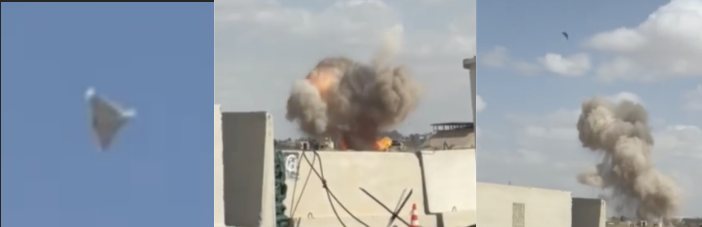
5 Key Points
- The Shahed-136a delta-wing, pusher-propeller airframe of roughly 200 kg launch weight, a 40–90 kg warhead, and an inertial-plus-satellite guidance package giving a commonly cited range of 1,000–2,500 km at about 185 km/h.[1]
- Its decisive attribute is economics, not sophistication. Units costing $20,000–$50,000 and employment in ongoing wars forces defenders to expend interceptors costing tens of thousands to several million dollars each, an unfavorable cost-exchange that can exhaust magazines faster than they can be refilled.[2]
- Production has industrialized far beyond Iran. Russia’s Alabuga plant in Tatarstan, built under a 2023 franchise deal, has driven output into the thousands per month and the per-drone price down from roughly $200,000 in 2022 to about $70,000 by 2025.[3]
- The blueprint-driven, composite-and-commercial-parts design has proliferated to Russia, the Houthis, Hezbollah, and Iraqi militias, and has been mirrored by the United States in its own low-cost clone, LUCAS, fielded under CENTCOM’s Task Force Scorpion Strike.[4]
- No single defense suffices. Current practice layers radar and acoustic detection, electronic-warfare jamming and GNSS spoofing, gun systems, interceptor drones, and missiles such as Coyote, while EW-resistant variants of the Shahed (fiber-optic, Starlink-linked, anti-jam antennas) steadily push the problem back toward costly kinetic defeat.[5]
Click here to read the full report
Winners Associate with Winners to Win!
Fight on!
Missile Defense Wins World Championships!