
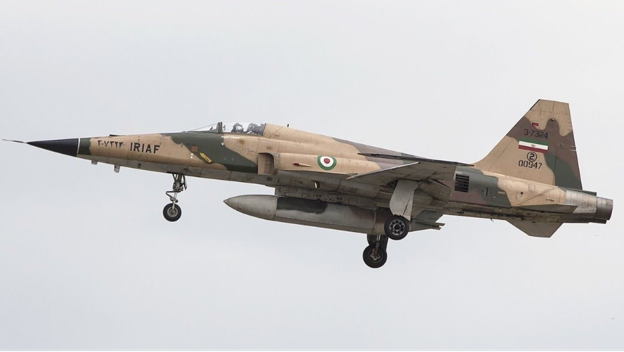
On March 1, 2026, an Iranian Air Force F-5 Tiger II — a platform which first flew during the Kennedy administration and was outclassed by Iraqi fighters in the 1980s and dismissed by most Western analysts as irrelevant to modern contested airspace. The F-5 successfully penetrated multi-layered U.S. and Kuwaiti air defenses and struck Camp Buehring.
The significance of the event lies less in the F-5’s performance specifications than in what its success reveals: a structural mismatch between the threats U.S. air defense architecture was designed to defeat and the low-altitude, low-cost, manned-platform envelope it was not. The broader lesson is uncomfortable. A doctrine optimized for ballistic missiles and sophisticated aircraft left a gap at the nap-of-earth. Iran flew through it.
The F-5 strike is not a sensor anomaly or a lucky shot. It is evidence that adversaries will find and exploit the seam between what a defense was designed for and what it was not
For purposes of the March 1 mission, the operationally relevant characteristics are what the F-5 lacks rather than what it possesses. It carries no radar-absorbent materials, no active electronic countermeasures, and no precision-guided munitions capability in its baseline configuration. Its radar cross-section is small relative to larger fighters — an accidental low-observable quality which complicates targeting. It is not an aircraft designed with stealth in mind. Its combat radius without external tanks is approximately 890 km, placing Camp Buehring in northwestern Kuwait at the outer edge of reach from southwestern Iranian basing locations. Crucially, the F-5 requires no satellite datalink, no persistent ground control, and no complex mission systems to execute a visual bombing run at low altitude. Its simplicity is not a limitation in this context. It is an enabler.
The Camp Buehring strike succeeded because of four reinforcing critical factors:
· Exploitation of detection geometry. The AN/MPQ-65 radar at the heart of the Patriot system is optimized for ballistic missiles and medium-to-high altitude threats. Its minimum engagement altitude creates a low-altitude blind cone beneath which a nap-of-earth aircraft is effectively invisible to the system. The F-5 did not defeat the Patriot. It flew beneath it.
· Cost-exchange asymmetry in reverse. Unlike the Shahed-136’s cost-exchange logic, which bankrupts defenders via mass, the F-5 mission inverted the asymmetry through irrelevance: a platform so obsolete that no defensive planner had modeled it as a credible threat vector. Systems were neither tasked nor cued against it. Confidence in Iranian Air Force limitations functioned as a de facto gap in the defensive architecture.
· Atmospheric and terrain exploitation. Separately, during Iranian strikes on Prince Sultan Air Base, Iranian aircraft and drones employed “ducting holes” — flying at specific low altitudes during atmospheric ducting periods to remain within radar blind zones, despite being technically within detection range. Whether this phenomenon contributed to the Camp Buehring penetration is unconfirmed; however, the tactical awareness it reflects is consistent with the broader Iranian approach.
· Precise intelligence preparation of the battlefield. Iran’s ISR architecture for the March 2026 strikes was more sophisticated than U.S. planners anticipated. Central to this architecture was a Chinese-built high-resolution Earth observation satellite acquired in late 2024 via a reported $36.6 million contract. This satellite provided Iranian commanders with detailed pre-campaign visibility into base layouts, defensive positions, radar placement, and operational patterns. Former U.S. Congressman and Air Force mission planner Denver Riggleman assessed that Iran’s ISR successes during the March exchanges demonstrated capabilities which caught American intelligence off guard, including the identification of specific seams in Camp Buehring’s radar coverage where detection geometry overlapped inefficiently or terrain created shadows.
Implications
The F-5 strike at Camp Buehring reveals a structural gap in U.S. forward base defense at the low-altitude, low-cost, low-complexity end of the threat spectrum. The U.S. had the technical capability to detect and engage the F-5 during its ingress. Airborne look-down, shoot-down radar systems capable of distinguishing moving targets from ground clutter have been operationally. The question Camp Buehring raises is not whether the technology existed, but whether it was positioned, networked, and tasked against a threat category no one had prioritized.
The primary defense against F-5-class threats in contested airspace is U.S. airborne assets — specifically fighters such as F-35s and sensor aircraft such as E-3 AWACS, and E-7s. The F-35’s sensor fusion and look-down radar enable detection and engagement of low-altitude, slow-moving aircraft that ground-based systems cannot effectively track. AWACS provides wide-area airborne surveillance with the look-down geometry that surface radar lacks, cueing interceptors against nap-of-earth ingress routes.
A ground-based look-up shoot-up solution exists and has been combat-operationally validated against Russian air threats for the past three years and on going today in Ukraine. Ukraine has deployed over 20,000 acoustic sensors to track and cue against low-flying Russian threats under 2,000 feet in a contested environment. MDAA has advanced this capability to NATO and in the Eastern Flank Deterrent Initiative as a critical layer for eastern border nations to defend their soverenty, infrastructures and base defense against exactly the nap-of-earth threat profile the F-5 exploited at Camp Buehring. Acoustic sensors require no radar emissions, are cheap, distritible and provide detection at altitudes where conventional air defense radars are blind. Integration of acoustic sensor networks outside and inside base perimeter defenses , networked to available effectors, interceptors and airborne assets, directly addresses the gap Iran exploited on March 1, 2026
Click here to read the full report
Fight On!