
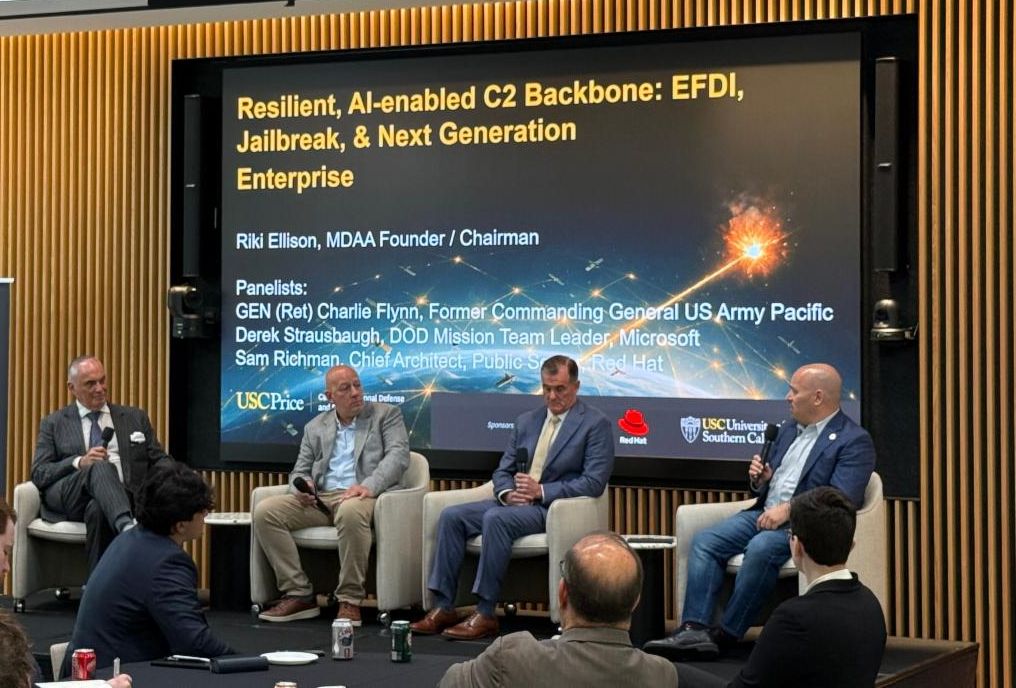
“So we’re unearthing stuff that’s been gone through before. But I do think it’s an interesting time for having this discussion, and an appropriate one. Unsurprisingly, I’m going to give you the Air Force operational perspective on this. When we look at Epic Fury — glass half-full, glass half-empty — I see it as more half-empty, just because I think it reveals some of the structural issues we have in the current structure, the misalignment of a couple of things here.
These are forward operating bases. When we protect ships out at sea, I see a parallel with what the Air Force is doing — except our ships don’t move, which makes it even harder. Damaged aircraft: three F-15Es shot down, one AWACS on the ground, five KC-135s damaged, and seven to eight MQ-9s destroyed. That’s at least a billion, if not a couple billion, right there. It’s even harder for the IAMD network: four AN/TPY-2 radars — that’s two billion right there — and then a billion worth of early-warning radar in the AN/FPS-132. So we have vulnerabilities here. Back in the 1960s — when I went to pilot training at Williams Air Force Base outside Phoenix, that’s where I’m from, it’s not there anymore — they used to train some of the Third World nations, even at that time, on F-5s. Yet they penetrated our Patriot, our air defense umbrella, by exploiting a 122-second window where they got in and dropped the things that go boom on this.
When I look at that, that’s when I ask: can this be our best setup? Not that it’s totally dysfunctional, but there are seams in it — and the enemy always finds the seams in every war. So with lives and billions of dollars of assets lost, our best model of execution needs to be something we look at. It’s worth a look. Seventy years, as Ricky said, of Key West and the Wilson architecture has produced — and this is my fundamental problem, as a recovering Air Force fighter pilot — the service with the responsibility but no equities defending someone else with all the equities but little authority. That doesn’t make sense to me.
That’s not how you wind things up for bureaucratic success. The greatest stake in all of this — in the installations anyway, and in installation survival — is the Air Force’s. And they have the least amount of authority. So to square that circle, you’d invert it. If you were setting up your own company, you’d invert it: you want the people with the responsibility to have the authority. Clearly — and over the years that Mark and I were both up on the Hill doing the policy-record work for the SASC — we saw this.
The Army prioritizes maneuvering forces. I want them to do that; that’s what I want the Army to do. But it also reflects in the budget. When that line gets just not quite long enough, the maneuvering forces aren’t the ones that are going to get short-sheeted — the other things are. If I were a ground commander with lives at stake, I can see why I’d prioritize that. It makes sense. But it’s a two-way problem.”
— Tom Goffus, Former Assistant Secretary General for Operations at NATO
Executive Summary
The central problem was framed as a decades-old misalignment rooted in the 1948 Key West Agreement, under which the service bearing the greatest risk to its installations holds the least authority over the defenses protecting them, while the service holding that authority prioritizes maneuver forces instead. One perspective argued for adopting the Ukrainian model, giving the air component commander integrated control over both interceptors and the full sensor suite, and realigning the Missile Defense Agency into an air-focused agency. Another characterized the breakdown as a three-part problem spanning organization, procurement, and concept, faulting a long-stalled interceptor program perpetually described as “two years away,” the absence of an affordable counter-drone and cruise missile defense, and a collective failure to capture lessons from three years of war in Ukraine. That same view praised an existing maritime modeling-and-simulation enterprise as a transformational, software-defined warfighting approach that ground-based air defense should emulate. A competing perspective held that ballistic missile defense should remain with ground forces, contending that air commanders should focus on generating air power while land forces handle base and airfield defense—a mission those forces can perform but for which they must be properly resourced. The dissolution of short-range air defense capability in the mid-2000s was cited as a cautionary example, noting that capabilities stripped away in three years take ten to fifteen years to rebuild. A recurring theme was the near-total absence of accountability, with panelists stressing that no single service or leader has been held responsible and that meaningful change requires clearly assigning who defends air bases and critical infrastructure. The discussion also surfaced enabling reforms, including more agile and failure-tolerant procurement, possible acquisition authority at the combatant command level, and a shift toward cloud-based, open-architecture data sharing to overcome fragmented, incompatible systems. The panel closed on urgency, arguing that converging pressures—the recent attack, lessons from Ukraine, the rise of space-based capabilities, and emerging homeland defense initiatives—make this the best opportunity in seven decades to fix roles and responsibilities, and that the change should be codified in the next defense authorization before another generation of misalignment is locked in.
I. Introduction and Framing
- A. The session addresses what panelists describe as a vital, long-deferred national defense issue
- B. The governing framework is traced to the 1948 Key West Agreement, characterized as a roles-and-responsibilities structure now overtaken by reality
- C. Specific losses cited: multiple fighter aircraft shot down, an early-warning aircraft destroyed on the ground, tankers and drones damaged or lost, and high-value radars (advanced fire-control and early-warning systems) destroyed
- D. Core thesis: the problem has been foreseeable and documented for years, but went unaddressed
II. The Structural Misalignment Problem
- A. The central contradiction: the service bearing the greatest risk to its installations holds the least authority over the defenses protecting them
- B. The service holding defensive authority prioritizes maneuver forces, which fare better in budget competition than defensive assets
- C. This is framed as a two-way problem—reluctance on one side to surrender the mission, reluctance on the other to fund it over competing priorities
III. The Three-Part Diagnosis: Organizational, Procurement, and Conceptual Failure
- A. Organizational
- No single service is responsible; this is a collective, system-level failure
- Risk to air assets was placed on one service while responsibility for defending them was placed on another
- The mission set was historically allowed to atrophy after years of fighting adversaries without significant air or missile threats
- B. Procurement
- A key interceptor program is characterized as a twelve-year failure, perpetually “two years away”
- The absence of a low-cost counter-drone and cruise missile solution left a choice between doing nothing and expending multimillion-dollar interceptors on cheap threats
- Larger, more expensive programs are described as the most prone to cost and schedule failure
- C. Conceptual
- Failure to convert three years of observable lessons from Ukraine into doctrine and capability
- Personnel deployed forward were positioned for purposes other than capturing joint lessons learned
- A “false sense of security” drawn from earlier successes that depended on geographic depth and transit time, conditions not always present
IV. Cross-Cutting Enablers and Reforms
- A. Procurement agility—permitting programs to be tested, to fail early, and to be canceled without penalizing the first attempts
- B. Combatant command acquisition and prioritization authority, referencing a prior initiative that let a commander direct priority funding without owning acquisition, and the sustainment risks that arise when capability is fielded without a logistics tail
- C. Data sharing and architecture
- Adversary and partner success enabled by open architecture and ubiquitous data sharing across many disparate systems
- U.S. systems hampered by proprietary, incompatible designs
- Proposed shift toward a cloud-based model with data-level security credentials rather than network-based segregation
- D. Underdeveloped areas: passive air defense, dispersal, hardening, deception and camouflage, and especially electronic warfare, where vast collected data goes unanalyzed
V. Conclusion: The Case for Acting Now
- A. Convergence of pressures making this a unique opening: the recent attack, lessons from Ukraine, the rise of space-based capabilities, and emerging homeland defense initiatives
- B. Warning that failure to act now defers reform by another full generation
- C. Recommended path: codify change through the defense authorization process, engaging the legislature, senior civilian leadership, and the chiefs
- D. Closing assertion that protecting key assets is inseparable from remaining a dominant global power, and a stated commitment to drive the issue forward
Speakers:
GEN (Ret.) Charlie Flynn
Retired 4-star US General
RADM (Ret.) Mark Montgomery
Former Director of Operations, U.S. Pacific Command
Mr. Tom Goffus
Former Assistant Secretary General for Operations at NATO
Mr. Riki Ellison
Founder & Chairman, MDAA
Click here to view the transcript
Winners Associate with Winners to Win!
Defense Wins World Championships!
Fight on!