
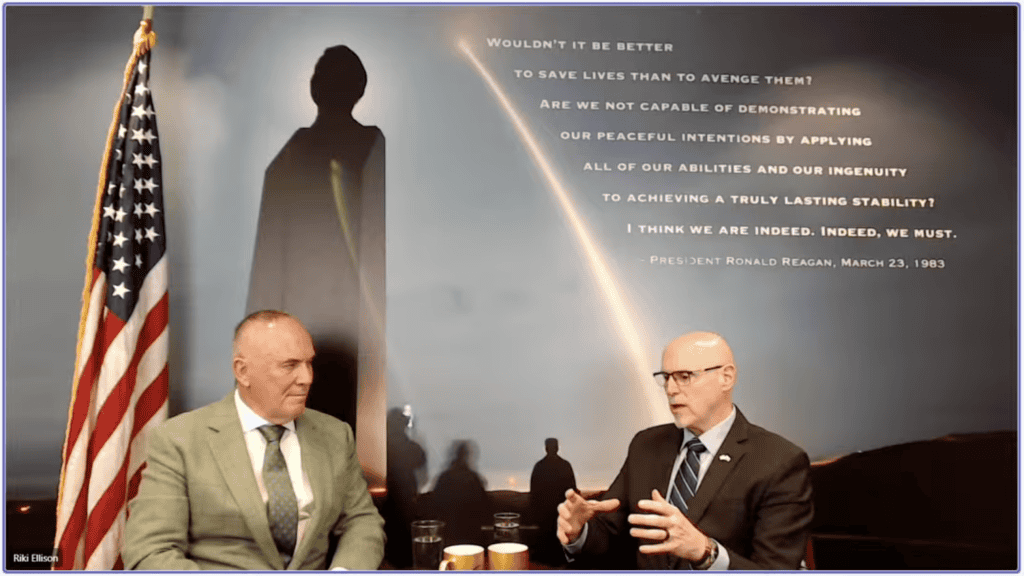
“Good afternoon, ladies and gentlemen. On a snowmelt day here. The sun is out, finally, here in Alexandria, Virginia. I want to congratulate, first off, the Seattle Seahawks for that great Super Bowl win over the weekend. And just seeing just a phenomenal defense that allowed the offense not to take risks and to be able to win that game. It was phenomenal. Defense wins Super Bowl championships, and I think it wins World Championships.
I’m Riki Ellison. I am the founder and chairman of the Missile Defense Advocacy Alliance.
It’s an alliance that I founded 20 years ago, but I’ve been involved with missile defense for 40 years and got involved with “Peace through Strength” with Ronald Reagan back in 1980 and the beginning of the Strategic Defense Initiative. We have a singular mission. Our mission is to make our nation safer and the world safer through the deployment, the evolution, and development of missile defenses. And we’re seeing that happen in real life every day, saving millions of lives, and just an absolute necessity for every nation in the world to have a capability on that. And we certainly are grateful for the President to initiate the Golden Dome to give us better coverage than we’ve ever, ever had in the history of our country.
Today, this is our 91st virtual, and we have, really, we have the honor to have the Honorable Dale Marks here, the Acting Deputy Undersecretary for Acquisition and Sustainment. It’s awesome to have you here. I also want to congratulate you on being a SHIELD alumni. Our first graduating class of our USC-MDAA partnership on SHIELD about five years ago, so it’s great to have a graduate here.
Our discussion today is going to go directly on the NDS 2026 National Defense Strategy document that was released by the Secretary of War a Friday or two ago, where the whole premise is peace through strength. And the four major points that are outlined in front, number one, defend the U.S. homeland. Number two, deter China in the Indo-Pacific through strength, not confrontation. Number three, increase burden sharing with U.S. allies and partners. And number four, supercharge the U.S. defense industry base.
Missile defense is in the four of each four of those elements. And certainly, I think the fourth one, the biggest for our future, our security, to get that right on top of that. And I want to go into that, because I’m calling it revolution. You call it supercharge. You call it reprioritizing. I’m calling it revolution. And I don’t think we’ve seen one. And you may go to Ronald Reagan, when we went through that peace through strength, Cold War apex against the Soviet Union, to break the Soviet Union, and missile defense was part of that breakage. I think you have to go all the way back to September. I think it was September 1, 1939, when President Roosevelt put General George Marshall in charge of the Army, and the revolution that he did to the Acquisition Department, to the Department of Defense, legendary, from 160,000 to 8 million troops, and built the greatest innovation, the greatest acquisition the world has ever seen. And that was born that way. And he had 43 generals, and he fired 32 of them to start off. So, it’s a culture change. And I think this is what this is, too. It is a culture change here.
So we’ve had the privilege over the last 20 years to visit hundreds and hundreds of bases, ships, our allies. And we know, we’ve seen the lack of inventory, of capacity. And it is ridiculous with missile defense. I’m just speaking missile defense capabilities on this. And it has to be addressed. And I want to thank you for seeing what I saw a week or two ago, when you announced the increase in the THAAD production, and the PAC-3 production. But we have a problem. We have a lot of problems. We have a couple key problems here, that we’re in wars, these cost of attrition wars, and our ability to shoot down things is, you know, 10 times, 15 times more than weapons being made to come at it. And we’ve seen this in the Red Sea every day. We’ve seen this. And we’ve seen this in Ukraine every day.
We simply cannot afford to keep that pace, especially on a bigger conflict with a much better and bigger opponent. You can’t do this without a revolution of getting out of the way of what we’ve done in the past. And all the hurdles, all the policies, all the stuff that has driven pricing up, driven the lack of capacity, and in some cases with our missile defense capabilities, our foreign allies. The Middle East are driving the production, not the United States, on our own stuff. And so that has to be addressed on it.
And let’s just look at those four things here. Let’s start with the US homeland. And I think people don’t realize that Mike Guetlein, General Guetlein is $175 billion, maybe $200 billion to develop an architecture and a system to defend the United States from everything. And that, by the way, he’s just building it. He passes that off to you as the acquisition sustainment to sustain that architecture. Which you have to look at, obviously, you have to add your input to make sure you can afford to be able to do it, to do it cheaper, quicker, faster, and to help him get this thing out there and the President in three years. I mean, I think there’s movement you have to go. And you cannot do this the way you’ve been doing any missile defense in the history of our country. So we are leaving that type of way and you’re leading the charge on this aspect of it.
And then on the second point, on the Indo-Pacific, we’re starting with Guam and our forward operating bases, which you were also in charge of, with both persistent missile defense capabilities for those forward operating bases and your ability to do expeditionary capabilities with that. But those are illfully not, they don’t have capacity at all. I mean, I’m just, I’ve been there. It’s not, it’s embarrassing. It’s embarrassing that we don’t have the capacity to defend. And again, none of us, you’re not even close to what Ukraine’s been able to do on a nightly basis to do that. We’ve got to deal with that aspect. And I think you look at the allied cooperation, and we’re certainly going to be looking at Canada, Japan, Australia to come in and bring part of this and Europe to do this. And we’ve seen a little bit of that in Ukraine, where the NATO has done a great job bringing other nations in to support. But this is a much bigger burden. And certainly we have to incentivize that aspect of that.
So I do also want to have you address a little bit on the critical minerals and how important that part of it, as you go through your kill chain production, how important that part of it is, because that’s come up a lot.
And then finally, I think the other thing is the mobilization. We can’t use 17 C-17s or 19 C-17s to move one Patriot unit. We got to change that. You’re going to have to get the capacity of the warfighter in front with speed and agility on that.
So we had the great honor to have Dale speak to our SHIELD team. We had our SHIELD program, our 2026 SHIELD program in the Pentagon about three weeks ago. And Dale gave a phenomenal presentation on this current situation. So I’ve asked him to come in here and sort of bring that presentation to the public on how you explained the situation we’re in this country to go forward. So ladies and gentlemen, Honorable Dale Marks.”
— Riki Ellison, 91st MDAA Virtual CRT
Executive Summary
I. Introduction
The Virtual CRT “Leading the Revolution of the Missile Defense Industrial Base” convened to examine how the United States can rapidly expand missile-defense capacity—faster, cheaper, and at scale—in alignment with the 2026 National Defense Strategy (NDS) emphasis on defending the homeland, deterring China in the Indo-Pacific, strengthening allied burden sharing, and “supercharging” the defense industrial base. Hosted by MDAA Chairman Riki Ellison, the discussion featured the Honorable Dale Marks, Acting Deputy Undersecretary for Acquisition & Sustainment, and centered on what both speakers described as a necessary culture shift in acquisition and production.
II. Strategic Context: “Speed and Volume” as the New Baseline
Marks framed the central operational imperative as speed and volume—ending an era of shallow magazines and slow replenishment by rapidly increasing production of proven systems while accelerating fielding timelines so weapons do not arrive “one day late.” The conversation emphasized that modern missile defense is a system-of-systems challenge (power, C2, warning time, supply chains), but that the immediate bottleneck is industrial capacity and the ability to replenish inventories quickly.
III. Industrial Base Mobilization: Scaling Mature Systems Now
A key takeaway was an aggressive approach to expanding output across the missile-defense and strike inventory. Marks cited a major example: PAC-3 production ramping from ~500/year to ~2000/year, followed by additional demand for even more capacity. He stated the scale effort extends across SM-3 (including 1Bs), THAAD, Tomahawk, and other air-to-air and air-to-ground systems—accepting that many are “exquisite” and expensive, but necessary to fill magazines rapidly.
IV. Incentives, Accountability, and the “Stable Demand Signal”
Ellison pressed the credibility problem: industry will not invest for surge production without confidence the demand will endure. Marks described a new posture built around multi-year deals to provide a stable demand signal, paired with direct CEO engagement, performance measurement, and accountability mechanisms (including monitoring corporate behavior and developing alternatives if firms cannot meet requirements). He argued that visible growth incentives can align shareholders with surge production—citing positive market reaction to major production agreements.
V. Cutting Bureaucracy: Acquisition Transformation and Culture Change
Marks explicitly acknowledged government as part of the problem and described a reform agenda intended to compress timelines and reduce self-inflicted friction. Central actions included:
- Implementing an acquisition transformation strategy focused on bureaucracy reduction and culture change
- Scrubbing FAR/DFARS and eliminating 2,700 regulations viewed as unnecessary
- Shifting to enterprise/portfolio management so portfolio managers can make fiscal trades and move faster
- Pushing workforce training changes through the Warfighting Acquisition University
VI. Helping Industry Go Faster: “Business Operators for National Defense”
The discussion highlighted a novel method for accelerating production performance inside industry itself: deploying hundreds of former CEOs/CFOs as “Business Operators for National Defense” to identify bottlenecks, improve throughput, and drive supply-chain performance down to lower-tier suppliers. Marks cited an example where a short deployment in a shipyard produced a 15% increase in production touch-point performance in 90 days—illustrating the thesis that capacity growth is as much operational discipline as it is money.
VII. Joint Demand Signal: Combatant Commanders as the “Customer”
A major institutional theme was shifting requirements and resourcing away from service-stovepiped optimization toward joint, operational demand. Marks stated that combatant commanders are the customers—the joint force demand signal should drive enterprise acquisition decisions. He pointed to reforms in requirements processes (JCIDS/JROC) and the move to designate executive agents for enterprise problems (e.g., drones) to avoid each service pursuing separate pathways.
VIII. Conclusion
The Virtual CRT concluded that industrial base surge, acquisition reform, and joint enterprise management are inseparable if the U.S. is to meet homeland defense and Indo-Pacific deterrence requirements at the pace demanded by today’s threat environment. The central message: missile defense cannot be scaled through incremental optimization of legacy processes—it requires a deliberate “revolution” in incentives, regulation, workforce, and production execution to deliver speed, volume, and readiness across the force.
Speakers:
Honorable Dale Marks
Acting Deputy Under Secretary of War for Acquisition and Sustainment
Riki Ellison
MDAA Founder & Chairman
Winners Associate with Winners to Win!
Fight on!