
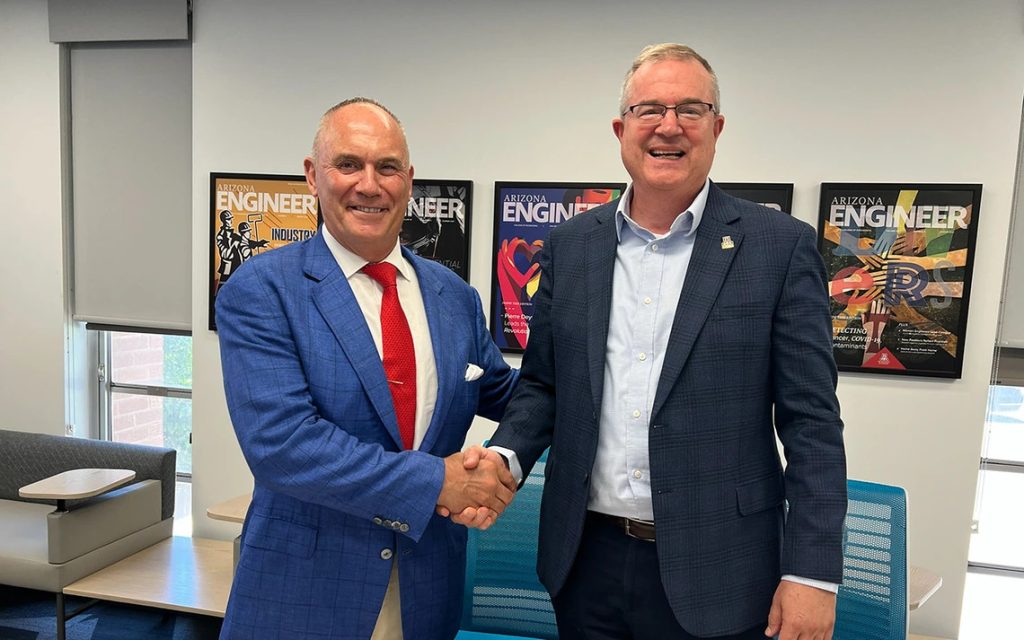
“Good morning and good afternoon from a beautiful sunny day in May in Tucson, Arizona at the campus of the University of Arizona in the prelude of Memorial Weekend. I am Riki Ellison. I am the founder and chairman of the Missile Defense Advocacy Alliance.
It’s an alliance that we formed in 2002 after 911, and I have been involved with missile defense since 1978. This is our 101st congressional roundtable, and it is very appropriate that it is near Memorial Day, since we are here at the University of Arizona-where there is a memorial of the ship at Pearl Harbor and the anchors of that ship are in this university. It is appropriate that this act is something we as a nation have come very close to with what happened in Epic Fury, with what happened to our bases forward that had adversary capabilities come in undefended, undetected, and took out billions and billions of dollars of our radars, our planes, and our bases, but most importantly some of our soldiers. And so, we recognize that.
We are here to discuss the future that’s coming upon us right now with mass automated drones we are seeing deployed, and it’s real. Last week, Russia fired a couple thousand in a night or two at Kiev and Ukraine. This is just the biggest amount ever fired over the last three years.
This is a real problem, and not one of our cities, not one including Washington DC, not one of our bases, not one of our forward operating bases can defend against an attack that just happened of thousands of systems coming into Ukraine. We have to get this solution correct, and when you’re looking at mass you’ve got to look at other ways of detecting it, of being able to negate it, and most of all, being able to coordinate and share data, share data across all agencies, all nations, and your allies, and to be able to do it outside of the baseline, to be able to have no gaps. So we are here at this center, at this university, where innovation happens for our 101st virtual roundtable on threats and opportunities for near space and border space for terrestrial operations.”
– Riki Ellison, 101st MDAA Virtual CRT(5/22/2026)
I. Executive Overview
The Missile Defense Advocacy Alliance (MDAA) convened its 101st Congressional Roundtable at the University of Arizona in Tucson, titled “Threats and Opportunities in Near/Border Space for Terrestrial Operations.” The discussion was led by MDAA Founder and Chairman Riki Ellison and brought together three panelists: Thomas “Shotgun” Browning, former Deputy Chief Technology Officer for Mission Capabilities at the Department of Defense and the first-ever Assistant Secretary of Defense for Mission Capabilities; Rear Admiral (Ret.) Mark Montgomery, former Director of Operations at U.S. Pacific Command and former Policy Director for Senator John McCain; and Dean David Hahn, Dean of Engineering at the University of Arizona. The roundtable was convened on the eve of Memorial Day weekend, framed explicitly around the lessons of recent combat operations in the Middle East, including
Operation Epic Fury, and the ongoing Russia-Ukraine conflict.
The roundtable focused on one of the most urgent and underexamined capability gaps in U.S. national defense: the growing threat posed by mass autonomous drone and missile attacks against American bases, forward operating positions, and the homeland itself, and the institutional, technological, and organizational failures preventing rapid adaptation. Panelists argued that the United States currently lacks the sensor architecture, command and control frameworks, effector capacity, and policy coordination needed to defend against modern drone swarm and missile saturation attacks — failures made apparent by combat losses sustained during Operation Epic Fury and by the unprecedented drone and missile raids Russia has launched against Ukraine. A second major theme was the announcement of a new University of Arizona academic partnership program called AETOS — Advanced Education in Terrestrial Operations in Space — which aims to harness university engineering expertise, student innovation, and defense collaboration to prototype solutions to near-space and terrestrial sensing, interception, and command and control challenges on an accelerated, nine-to-twelve-month capstone cycle.
Throughout the discussion, panelists emphasized the threat environment is not bounded by traditional military categories. Drone and missile attacks no longer emanate solely from nation-states; cartels, terrorist organizations, and non-state proxies now possess long-range precision strike capabilities. The United States must therefore dissolve the institutional barriers separating military, law enforcement, and homeland defense responses — without sacrificing civil liberties — in order to build a unified, scalable, and adaptive defense architecture.
II. Strategic Themes and Major Discussion Areas
The Threat Has Outpaced the Defense
Riki Ellison opened the roundtable with a stark assessment: not a single American city, military base, or forward operating base is currently capable of defending against a mass drone attack of the scale Russia recently launched against Ukraine — thousands of drones fired in a single night. He linked this directly to American operational failures during Epic Fury, in which undetected, undefended inbound drones and missiles destroyed billions of dollars of radar systems, aircraft, and base infrastructure, and killed American soldiers.
Ellison and the other panelists argued that the United States has been structurally slow to recognize drones and low-cost precision missiles as primary weapons of modern warfare rather than peripheral threats. The failure is not primarily one of technology but of institutional prioritization, acquisition culture, and strategic imagination.
The Interagency Problem: Military, Law Enforcement, and Homeland Defense Must Converge
Thomas “Shotgun” Browning argued that one of the most important and underappreciated challenges is the artificial institutional separation between military, law enforcement, and intelligence authorities. He emphasized that a drone crossing the southern border does not identify itself as a military threat, a terrorist weapon, or a criminal tool. The appropriate response must be agnostic to that categorization, yet U.S. law, culture, and bureaucratic structure currently prevent military and law enforcement organizations from sharing data, sensors, or decision authorities in real time.
Shotgun argued that advances in AI-driven data architecture now make it technically feasible to fuse classified military data with law enforcement and civilian data in a manner that protects individual privacy. By keeping personal data encrypted and non-extractable within a fused system — accessible only as aggregated threat information the government could eliminate the dangerous seams between military and domestic defense without violating civil liberties. He described current workarounds as “Rube Goldberg” solutions that technology has now made unnecessary.
The Kill Chain Must Be Built on a Unified Architecture
Shotgun introduced what he called “the rubric” — a foundational framework for any effective kill chain: command and control, communications, and position/navigation/timing (PNT) form the backbone, into which weapons, platforms, and sensors must be integrated. He argued forcefully that sensing alone is insufficient, “perfect surveillance never killed anybody” — and that the most dangerous mistake is to develop sensors, shooters, and command systems in organizational isolation. Every element of the kill chain must be designed from the start to operate as an integrated system.
He further argued that the current U.S. defense acquisition model — in which each service, each combatant command, and each program office independently develops its own command architecture, sensing systems, and communications protocols — has produced a fragmented, duplicative, and ultimately ineffective layered defense. He called this outcome “sad C2,” contrasting it with the Joint All-Domain Command and Control capability the Pentagon had sought for years.
Sensing Architecture: Near Space, Aerostats, and Distributed Networks
A major technical discussion thread focused on the sensing gap in the near-space and low-altitude terrestrial environments — altitudes between 60,000 feet and the von Kármán Line (roughly 62 miles), as well as the treetop-to-low-altitude flight paths used by modern drones. The panel argued that this region is poorly covered by both space-based and conventional ground-based sensors, and that innovative platforms — including tethered and untethered aerostats, high-altitude long-endurance unmanned aircraft, solar-powered balloons, and suborbital vehicles — represent underinvested opportunities to close this gap.
Admiral Montgomery described the Ukrainian counter-drone fusion center model in detail: thousands of sensors — acoustic, radar, electronic warfare detection, and video — feeding into an unclassified cloud-based picture, with operators selecting kinetic or electronic countermeasures in near real time. He emphasized that the system works precisely because it is unclassified and widely distributed: if the adversary compromises a handful of sensors, the 95% that remain operational still provide actionable situational awareness. He argued the United States should build an analogous architecture domestically, accessible not only to military units but also to Department of Homeland Security, law enforcement, and eventually state and local agencies.
Shotgun Browning highlighted several sensing modalities the panel considered underutilized: electronic signal detection (triangulating drone communications and guidance systems), acoustic networks enhanced with AI and aerodynamic modeling (capable of distinguishing drone signatures from ambient noise), radar at weight and power constraints compatible with balloon and high-altitude platforms, and fusion of open-source information — including social media — with traditional military and law enforcement feeds.
Defeating Mass: Effector Strategies Against Drone Swarms
The panel engaged in a substantive discussion of how the United States can develop cost-effective effectors capable of defeating drone raids measured in the thousands. Montgomery argued that kinetic missiles alone cannot provide a cost-competitive, scalable solution against mass drone attacks, and that the United States must invest in low-cost counter-drone interceptors — similar to the systems Ukraine has deployed — operating on unclassified, broadly shared networks accessible to military and civilian agencies alike.
Browning outlined several non-kinetic and scalable effector approaches the panel considered most promising:
• Directed kinetic fire — bullets and cannon rounds — already deployed effectively by Ukraine against low-cost drones, representing the lowest cost-per-kill option for shorter ranges.
• High-powered radio frequency (RF) weapons capable of simultaneously disabling multiple drones within a broad airspace — a “one-to-many” effect that laser and kinetic systems cannot achieve.
• GPS and navigation jamming, exploiting the deep reliance of most affordable long-range drones on space-based navigation — a vulnerability that can be disrupted at scale and at low cost.
• Electronic warfare targeting drone communications links, forcing adversaries into constant RF adaptation and reducing the effectiveness of fire-and-forget systems.
• Directed energy (laser weapons), noted as a viable addition to the effector mix, with acknowledged limitations around beam divergence, the risk of inadvertent satellite engagement, and one-to-one engagement geometry.
Montgomery also argued that for ballistic missiles, hypersonic, and exquisite long-range threats, space-based intercept — as envisioned in the Golden Dome architecture — remains the appropriate investment tier, and that the $1.2 trillion cost estimate should be evaluated as roughly 3.2% of the projected defense budget over 20 years, not as a lump-sum shock figure.
Command and Control: Fragmentation as a Strategic Vulnerability
Both Browning and Montgomery identified the fragmentation of C2 architecture across services and combatant commands as among the most dangerous institutional failures in U.S. defense posture. Each service is currently developing its own C2 architecture, its own sensor integration approach, and its own communications systems — independently of both each other and of the Golden Dome construct. The result is costly duplication, incompatibility at the operational seams, and dangerous gaps in integrated defense.
Browning argued that the technical problem of how to sense, shoot, and command in the modern threat environment is no longer fundamentally different based on whether an asset is afloat, airborne, or on the ground. He called for a single, domain-agnostic entity — whether that is the Missile Defense Agency, a new office, or the Strategic Capabilities Office — empowered to design and enforce a common architecture across all services and commands.
Montgomery reinforced this by pointing to the lessons from the failure to protect U.S. bases during Epic Fury, noting that the MDAA had warned about the inadequacy of Army-centric ground-based defense three years earlier and had proposed a clearer division of roles and responsibilities. That paper was “broadly ignored,” and the operational result was the destruction and casualties that followed.
The University of Arizona AETOS Program
Dean David Hahn announced the launch of the AETOS program — Advanced Education in Terrestrial Operations in Space — a new non-partisan educational and research initiative designed to bring together military personnel, defense industry professionals, agency representatives, and allied partners with University of Arizona faculty and students to develop prototypable solutions to near-space and terrestrial defense challenges.
The program, named after the Greek golden eagle Aetos (messenger to the gods), mirrors the structure that MDAA has previously established at the University of Southern California (SHIELD program, 107 graduates) and the University of Hawaii.
Key features of the AETOS program include:
• Formal education modules covering space domain awareness, optics, acoustics, drone systems, aerostats, hypersonic, and directed energy.
• Nine-to-twelve-month capstone design projects producing working prototypes addressing real operational capability gaps.
• Collaboration with combatant commanders and functional commanders to ensure capstone topics address real operational needs.
• Existing University of Arizona capabilities in hypersonic wind tunnels (tested to Mach 5 in collaboration with Raytheon), directed energy and laser research, acoustic sensing, quantum systems, and advanced materials.
• Active partnership with MDAA, with the first capstone cohort expected to deliver results within nine months.
Dean Hahn highlighted one concrete example of university-defense collaboration already producing results: University of Arizona researchers have successfully disrupted hypersonic boundary layer conditions using laser energy in a hypersonic wind tunnel, demonstrating a potential pathway to aerodynamically destabilizing incoming hypersonicThe roundtable revealed a coherent and mutually reinforcing strategic picture across all three panelists, despite each bringing distinct professional perspectives.
Browning framed the problem technologically and institutionally: the kill chain must be integrated from the outset, current fragmentation is self-inflicted, and the era of multi-decade acquisition programs for single-purpose systems must end. He argued that the half-life of any defensive technology is now measured in single-digit years, not decades, and that systems must be designed for continuous evolution rather than stable deployment.
Montgomery framed the problem operationally and organizationally: the United States has repeatedly been warned about specific vulnerabilities — from the MDAA’s roles and responsibilities paper to years of advocacy for unclassified sensor networks — and has repeatedly declined to act, with strategic consequences now visible in combat losses. He emphasized the Ukrainian model of distributed, unclassified, sensor-fused counter-drone defense is not exotic: it is a proven architecture that the United States should adopt, adapt, and share with partners including Saudi Arabia, UAE, Taiwan, Israel, and others.
Dean Hahn framed the problem educationally and innovatively: American universities possess exactly the kind of breadth, technical expertise, and nimble prototyping capability that defense acquisition programs lack. The AETOS program represents a direct institutional response to the warning that great sensing and engineering ideas are being produced at universities but dying in bureaucratic transitions before reaching the
warfighter.
Taken together, the panel described a defense posture that is winning at the high end — offensive strike, space, nuclear deterrence — while failing at the operational middle tier: the defense of bases, forward units, border regions, and the near-space domain against mass autonomous attack. The strategic warning of this roundtable is that this gap, if unaddressed, will be ruthlessly exploited by adversaries — whether state or non-state — who have already demonstrated their willingness and ability to use drones and missiles at industrial scale.
IV. Key Strategic Takeaways
• No American city, military base, or forward operating position can currently defend against a mass drone attack on the scale Russia has already employed against Ukraine.
• The threat is not bounded by military categories: cartels, terrorist groups, and non-state proxies now possess long-range precision strike capability, requiring military-law enforcement-homeland defense convergence.
• The kill chain must be treated as a unified architecture of C2, communications, PNT, sensors, and weapons from the outset; piecemeal development across services and commands produces dangerous seams.
• Near-space and low-altitude terrestrial sensing gaps must be closed through aerostats, high-altitude platforms, and distributed unclassified sensor networks modeled on Ukrainian counter-drone fusion centers.
• Defeating mass drone attacks requires scalable, low-cost effectors — kinetic rounds, RF weapons, GPS jamming, electronic warfare — not solely premium interceptor missiles.
• C2 fragmentation across services and COCOMs is a self-inflicted strategic vulnerability; a single domain-agnostic entity must be empowered to enforce a common architecture.
• Universities offer nimble prototyping, broad technical expertise, and the ability to develop unclassified innovations at the early TRL stages where the defense-industrial base is least effective.
• The half-life of any defensive technology is now measured in years, not decades; acquisition programs and capstone projects alike must be designed for rapid iteration and evolutionary improvement.
• The University of Arizona AETOS program — Advanced Education in Terrestrial Operations in Space — represents a new academic-defense partnership designed to produce prototypable solutions to near-space and terrestrial defense challenges within a nine-to-twelve-month cycle.
V. Conclusion
The 101st MDAA Congressional Roundtable delivered a clear and urgent message: the United States is actively losing ground in the operational middle tier of modern warfare, specifically the defense of forces, bases, and the homeland against mass autonomous drone and missile attack. This failure is not primarily a function of technological deficiency. The technologies to sense, intercept, and command against these threats exist, are being demonstrated by allies and partners in active combat, and in some cases have been available for years. The failure is institutional, organizational, and cultural.
The roundtable identified a set of concrete and actionable responses. Building unclassified, distributed sensor networks modeled on Ukrainian counter-drone fusion centers. Investing in scalable, low-cost effectors — kinetic, RF, electronic warfare — alongside high-end interceptors. Establishing a single domain-agnostic command authority to enforce a common C2 architecture. Dissolving the legal and bureaucratic walls between military and domestic defense through AI-enabled data fusion that protects civil liberties. And, accelerating prototyping through university partnerships capable of delivering working capabilities on acquisition timelines measured in months rather than decades.
The launch of the AETOS program at the University of Arizona represents exactly the kind of concrete institutional action the panel called for: a non-partisan, engineering-grounded, operationally connected program designed to produce results at the speed the threat demands. Combined with the MDAA’s existing programs at USC (SHIELD) and the University of Hawaii (ARTEMIS), the AETOS partnership creates a growing network of academic centers capable of feeding innovations directly into the operational defense architecture.
The strategic warning issued at this roundtable was unmistakable and consistent with the warnings issued at the 100th: the adversary is watching, adapting, and already exploiting institutional rigidity faster than the Pentagon can respond. Unless the United States acts with urgency — not at the speed of programs of record, but at the speed of the threat — the operational losses of Epic Fury will be a preview, not an anomaly.
Click here to view the transcript
Click here to view the recording
Click here to view the University of Arizona Article
Click here to view the NBC 12 News Article
Click here to read the KOLD News 13 Article
Click here to read the Arizona Daily Star Article
Click here to read the Arizona Technology Council Article
Click here to read the Arizona Republic Article
Click here to watch the KOLD News 13 Video
Winners Associate with Winners to Win!
Bear Down!