
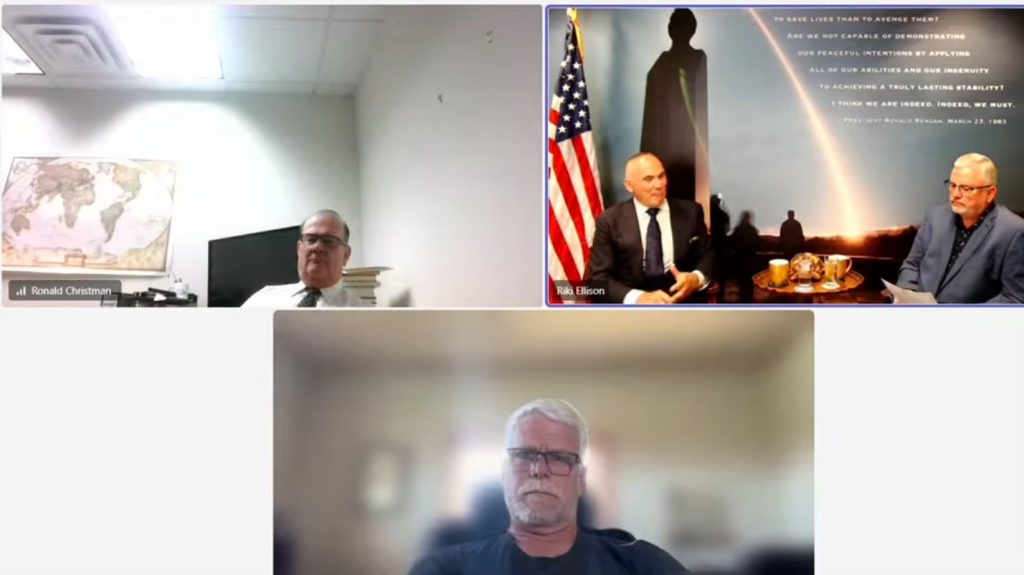
“Good morning, ladies and gentlemen, from a muggy July day here in Washington, D.C., in Alexandria, Virginia, coming off our 250th birthday as a nation. We’re excited to be here. I’m Riki Ellison. I’m the Chairman and Founder of the Missile Defense Advocacy Alliance, and our mission is to make the world a safer place, and our nation a safer place, through the development, the deployment, and the evolution of missile defense. I’ve been doing this for 46 years, and MDAA was founded about 20 years ago. Our job — it’s not a job, it’s what we love to do — is to illuminate, educate, and advocate for missile defense. And we’ve done it. And we have been right. We have been right.
With that evolution of missile defense, and with the cost curve the way it is, directed energy is the future to reduce that cost curve. It is a system that we’re very familiar with, and it goes all the way back 40 years. It was put forward by President Reagan. It was put forward by Edward Teller — I had the opportunity to be lectured by him in 1980 — on how this system could defeat any ballistic missile, any ICBM, from space. That was the evolution of the technology 40 years ago. And we had another opportunity 20, maybe 30 years ago, when we broke out of the ABM Treaty and North Korea was creating ICBMs. One of the solutions for that was an airborne laser. It was developed on a 747 — a chemical-based laser — and we shot down missiles off the coast of California in the early 2000s. A phenomenal system. And the plan was to do CAPs around the Korean Peninsula. But due to administrations, due to policy — mostly policy — they took it away.
As we’ve evolved, we’ve spent hundreds of millions of dollars in the labs, across our defense contracting industry, to create directed-energy lasers that have shot down drones and cruise missiles. And two weeks ago, on June 24th, under the Secretary of War, Pete Hegseth, out in New Mexico — where Shotgun’s from — they announced they shot down a cruise missile, essentially, with directed energy. This is not the first time. But if we look at what directed energy is, it may be an exotic weapon system, technically, today — and fielding it in space, in near space, in the air, on land, and at sea, in all those domains — still, it will always be a supplementary interceptor compared to our kinetic interceptors. It’s not strong enough to do that. And I say that for three distinct reasons.
The first one is force posture. You have to put this system forward and be able to defend it. We are unable to do that today. We know what happened with Epic Fury. And even in our safe United States, the threat that we saw in Epic Fury, by Iran, on our bases, is absolutely real for our nation. I’ve had the opportunity in the last two weeks to be out there — I was in L.A. at Space Systems, I was in Hawaii at INDOPACOM, I was in Guam for Valiant Shield, I was in [South] Korea, and I was back over in Germany with Europe. All of them require a missile defense against cruise missiles. And it’s not what our fighter pilots here want to hear — it’s not fixed-wing air-to-air capabilities, which we are having to do, and doing very expensively. But you cannot handle the mass. And we’ve got to talk about the mass — whether lasers can actually handle mass, because they’re one-shot systems. Right now, if you’re going to put forward a system and you can’t force-protect it, that’s a huge challenge.
The second thing is infrastructure, because directed energy requires an immense amount of power, and all the infrastructure has to be built around that to put it in play. And the last thing is the network. You’re going to have to be able to put all the data from all the other sensors and capabilities you’ve got into the system. So I’m saying right now, we don’t have those three things. We may have the technology, but we don’t have those three big babies that need to be developed and moved. And that is where Golden Dome is primarily in play. And I would even venture — because I know we’re not going there yet — that our space-based interceptors should also be looking at laser capability, like we did in the 1970s, to be able to move on that.
But Golden Dome is working toward creating limited-area defense systems — underlying infrastructures around our nation that could provide the power and the capabilities to enable that system and force-protect that system. But most important is the network. It is the C2 that Golden Dome is supposed to be doing, and they are doing it successfully, because they did that test two weeks ago. And I think the biggest success, which nobody talks about, is how they were able to bring in six different data streams in the C2 to cue that laser to intercept successfully. So it’s exciting. It is real, but it’s still very premature in its ability to deploy fast and quick. Hopefully we may have this capability in the United States under Golden Dome by ’28. But more importantly, we’re not going to wait until ’28 to defend our forward operating bases. We cannot wait until ’28. So there needs to be more aggressive risk-taking — which we don’t see in the Pentagon, as we know, and these gentlemen have lived that — to take risk and put this out there as a supplement to what we have.
The world is in a very challenging place right now, with Russia and China challenging our world order. And they’ve been pretty good at doing that. Things are happening — they’re thinking about bigger conflicts or bigger ways to move that influence. So this is certainly an offset, but we have to be much more aggressive than we are today in getting it in play.”
– Riki Ellison’s Opening Remarks, 102nd MDAA Virtual CRT
I. Executive Summary
The Missile Defense Advocacy Alliance (MDAA) convened a Virtual Congressional Roundtable titled “Lasers Defeating Cruise Missiles,” hosted from Alexandria, Virginia, in the week following the nation’s 250th birthday. The discussion was led by MDAA Founder and Chairman Riki Ellison and brought together two panelists with deep directed-energy and defense R&D experience: Thomas “Shotgun” Browning, MDAA board member, former DARPA official, former Deputy Chief Technology Officer for Mission Capabilities at the Department of Defense, and former vice commander of air forces in Iraq; and Randall “Fu” Parker, a former F-15 pilot with more than two decades of experience in defense research and development and special projects.
The roundtable was convened in direct response to a milestone event: on June 24, at White Sands, New Mexico, the Department of War announced the successful shoot-down of a cruise missile with a directed-energy weapon — a demonstration cued, notably, by a Golden Dome command and control architecture fusing six separate data streams. The discussion placed that achievement in the context of a 40-to-50-year history of successful laser demonstrations that never transitioned into fielded capability, from the Reagan-era Strategic Defense Initiative and the MIRACL and COIL programs, through the Airborne Laser’s successful intercepts off the California coast in the early 2000s, to DARPA’s HELLADS and the Air Force’s terminated SHiELD effort.
The central message of the roundtable was twofold. First, directed energy is real, timely, and increasingly essential: the cost curve of modern air and missile defense — million-dollar and ten-million-dollar interceptors expended against low-cost drones and cruise missiles — is driving the nation toward lasers faster than any other consideration. Second, directed energy will remain a supplementary effector, not a replacement for kinetic interceptors, and it will never mature into a genuine warfighting capability until the United States breaks its decades-long cycle of “kick-ass demo, press release, boneyard” and puts imperfect first-generation systems into the hands of operational warfighters. The losses sustained during Epic Fury — twenty bases struck, aircraft and radars destroyed on the ground — supplied the urgency: base defense against cruise missile and drone mass is an operational requirement today, not a 2029 or 2030 problem.
II. Strategic Themes and Major Discussion Areas
Directed Energy Is Supplementary — and Gated by Three Enablers
Riki Ellison framed the discussion by arguing that, despite four decades of technological promise dating back to Edward Teller and President Reagan, directed energy remains a supplement to kinetic interceptors, constrained by three unresolved enablers. First, force posture: a laser system deployed forward must itself be defended, and — as Epic Fury demonstrated against U.S. bases — the United States cannot currently force-protect its forward positions against saturation attack. Second, infrastructure: directed energy demands immense power generation, and bases at home and abroad are already maxed out supporting radars and sensors. Third, the network: laser effectors are useless without the sensor fusion and command and control to cue them. Ellison argued Golden Dome is precisely the vehicle for building these three enablers, and identified the underreported success of the June 24 test as the C2 achievement — six data streams fused to cue a successful intercept. He projected initial capability under Golden Dome by 2028, while insisting forward operating bases cannot wait that long and more aggressive Pentagon risk-taking is required now.
Breaking the Demo-to-Fielding Cycle: “The First One Sucks”
Shotgun Browning delivered the roundtable’s sharpest institutional critique: the United States has a 40-to-50-year track record of successful laser demonstrations and an abysmal record of converting them into fielded capability. The COIL laser became the Airborne Laser, which took ten years to first firing, five more to first shoot-down — and was canceled two years after succeeding. HELLADS succeeded at White Sands and ended. SHiELD was terminated without ever flying. Each cycle ends with scientists turning keys in a room, a congratulatory press release, and a return to old business.
Browning’s prescription rests on his recurring axiom that “the first one sucks”: every transformational weapon — the first heat-seeking missiles, first jet aircraft, first radar-guided missiles — was initially inadequate, and became dominant only because it was fielded, used, and criticized by warfighters. He invoked the electric car as the model: viability came only after the product reached users who demanded more range and less weight. What directed energy needs, he argued, is a “Billy Mitchell, Wright Brothers moment” — commanders willing to employ the technology while it is still awkward and unproven, generating the tactics, techniques, and procedures that no laboratory can. Critically, he distinguished this from tossing toys to the field: the goal is fielding genuine operational systems with the follow-through and resources to absorb warfighter criticism and iterate — not, as he witnessed at the end of Operation New Dawn in Iraq, “hangars full of good intentions” of abandoned counter-IED demos.
The Rubric: No Effector Matters Without Integrated Architecture
Browning reintroduced the framework he credits to Dr. Jim Galambos — “the rubric” — holding that every kill web rests on a foundation of battle management/command and control, communications, and position, navigation, and timing, into which sensors, platforms, and weapons are integrated. Adversaries in the Middle East and Eastern Europe do not send single, scheduled cruise missiles against waiting defenders; they send mass along unpredictable timelines. Defeating that requires C2 that links Patriots, fighters, and ground-based lasers, makes real-time targeting decisions, deconflicts shooters, and exploits the optimal capability of each effector. Both panelists agreed that lasers will never be integrated into that architecture — nor will the architecture itself mature — unless lasers are physically in the field as part of it.
Domain Trade-offs: Power, Weight, Range, Geometry
The panel worked systematically through the physics and operational trade space across domains:
Point defense (land and sea). Where the defender knows exactly what the adversary wants to hit — a radar, a ship — lasers are, in Browning’s words, a “no-brainer” and the most economical answer. Naval self-defense is particularly natural because the ship is the target. Had lasers surrounded U.S. radars in the Middle East, Iranian strikes would have been far less successful.
The engagement-geometry problem. Ellison highlighted a critical limitation: current systems struggle to bore through the nose of an inbound cruise missile and need side-aspect shots against the greatest surface area — geometry a fixed point defense rarely gets against a threat flying directly at it.
Airborne lasers. Browning argued this is precisely why airborne platforms — manned or unmanned — are a critical additive component. Drones and cruise missiles now fly for hours, not minutes. With adequate sensing, an airborne laser can be positioned along the threat’s route, choose its target point and intercept geometry, match the missile’s speed, and kill it long before it reaches the defended asset. Elevation also mitigates atmospheric attenuation and extends line of sight.
Space-based lasers. Aiming lasers across vast distances is proven technology — satellite laser communications are operational today. The open question is purely one of power: delivering enough energy to injure rather than communicate. Boost-phase intercept from a thousand miles is likely the wrong laser mission; boost-phase from an elevated or airborne platform absolutely can make sense. Ellison pressed the case for Golden Dome to pursue space-based laser interceptors, noting presidential authorization appears to exist.
The universal constraint. More power equals more weight equals more expense and fragility. A light, mobile, low-power laser cannot handle a raid; a laser wired into massive power can — but is not mobile. Every design is a position on that curve.
Fu’s Amplifications: Autonomy, Safety, Magazine Depth, and Heat
Randall Parker contributed a practitioner’s inventory of the less-discussed constraints. The June 24 demo included prescribed autonomy; drone and cruise missile kill chains permit some human deliberation, but the ballistic side is “ripe” for faster-than-human, human-on-the-loop autonomy — which, like human operators, will only reveal its failure modes through real-world exercise in congested environments. High-energy lasers are not eye-safe and are hazardous to optics; peacetime laser clearinghouse deconfliction protects airliners and satellites, but in a major shooting war those windows must be tight enough to shoot immediately without committing fratricide. He identified heat dissipation as the neglected twin of power generation — even in space, shedding heat is hard, forcing shoot-cool-shoot cycles — and named magazine depth as the enduring limit until systems proliferate across domains. Orbitology, shooter-to-target aspect, and placement CONOPs for ground-based point defense all remain underdeveloped; too little time has been spent with air defenders working multi-threat CONOPs. His summary maxim: “you’d be a fool to rely on space; you’d be a fool not to account for space.”
He also addressed technology direction: the world has moved decisively to solid-state lasers, in part because the chemical logistics chain helped kill the ABL. Solid-state can be ruggedized and handed to a soldier; if it can deliver the required power, responsiveness, and magazine, it removes an entire layer of operational burden.
Who Owns This? Accountability and Fiscal Priority
Ellison identified four candidate organizations to carry directed energy forward: Golden Dome (already heavily tasked), the Missile Defense Agency (heir to SDIO and the ABL, underutilized), the Army (long resident at White Sands), and — a new opportunity — the U.S. Air Force, which following Corona has assumed the counter-UAS base defense mission for its own installations. Browning’s answer was deliberately agnostic on the “who”: services organize, train, and equip, and any service will do. What matters is the “what” — that the tasked entity be resourced to aggressively acquire capability, accepting both technical and operational risk early. For years, he argued, annual budget decisions declined to accept risk on unproven technology and declined to adequately fund base defense — which is precisely why the discussion is necessary. Ellison added the accountability dimension: twenty bases were destroyed in Epic Fury, no one has been held accountable, and the services that lost the most are the ones most motivated to make the hard trade-space choices from offense to defense and carry that request to Congress and a receptive President.
Timelines: Pessimism, Realism, and a 2028 Wager
Asked when an operationally deployed laser will defend warfighters in combat, the panel diverged instructively. Parker held that a system is not a capability until units can train with it and execute it; on the normal path it takes years, varying by service and domain, though autonomy and simplified operation could compress that. Browning was bluntly pessimistic: absent a break in the cycle, ten years from now there will be another impressive demo at White Sands and another round of advocates on television. The circuit-breaker is a commander who cannot execute an assigned mission without the capability — and he believes that commander already exists. Fielding “the first one that sucks” tomorrow could make the United States best-in-breed within a couple of years, but only if it starts. Ellison closed more optimistically: the nation will take the risk and field capability by 2028, “because we’re going to keep losing our bases until we take some hard risk.”
The panel also endorsed folding directed energy into the emerging automated command construct in the current NDAA: bullets, missiles, bombs, lasers, cyber, and RF energy are all one suite of effectors, and every command — service or autonomy-centric — should have lasers in its architecture where tactically and fiscally appropriate.
III. Key Strategic Takeaways
The June 24 White Sands cruise missile shoot-down proves the technology — and its most underreported achievement is the Golden Dome C2 fusion of six data streams to cue the laser.
Directed energy is a supplementary effector, not a replacement for kinetic interceptors; its promise is bending the cost curve against mass drone and cruise missile attack.
Three enablers gate fielding: force protection of forward-deployed systems, power and cooling infrastructure, and an integrated sensor/C2 network. The technology exists; the enablers do not.
The United States has a 40-to-50-year pattern of successful laser demonstrations followed by cancellation. Breaking the demo-to-boneyard cycle requires fielding imperfect systems — “the first one sucks” — with follow-through, not hangars of abandoned good intentions.
Airborne lasers are a critical additive layer: hours-long threat flight times allow elevated platforms to choose intercept geometry, attack side-aspect, and kill threats en route rather than over the defended asset.
Point defense is the near-term no-brainer, especially naval self-defense and protection
of high-value assets like radars; moderate-power systems with self-contained power exist in the field today.
Autonomy is essential for the ballistic timeline and valuable everywhere, but carries fratricide and collateral-damage risk that can only be retired through real-world exercise; laser safety deconfliction must become fast enough for wartime.
Magazine depth, heat dissipation, orbitology, and placement CONOPs are the underexamined constraints; solid-state lasers have largely displaced chemical systems for logistical reasons.
Ownership matters less than resourcing: whichever entity is tasked — Golden Dome, the Army, or the Air Force under its new counter-UAS base defense mission — must be funded to accept risk and acquire at scale, with accountability for the bases lost in Epic Fury driving urgency.
Timelines diverge from a pessimistic ten-more-years-of-demos to Ellison’s 2028 projection; the variable is not technology but fiscal fortitude and leadership willing to start.
IV. Conclusion
This roundtable delivered a message that was simultaneously encouraging and cautionary. The encouraging half: directed energy works. It has been shooting down missiles in demonstrations for a quarter century, the June 24 test validated both the effector and — more importantly — the integrated, multi-stream command and control needed to employ it, and the current administration, the Department of War, and the Golden Dome enterprise have created the most favorable policy and funding environment for lasers in decades. The cost mathematics of modern air defense — exquisite interceptors traded against cheap mass — make directed energy not a luxury but a necessity.
The cautionary half: none of this is new. The nation has stood at this threshold repeatedly since the 1980s and has, every time, chosen the demo over the fielded system. Both panelists agreed the barrier is no longer physics — it is fiscal priority, risk acceptance, and institutional spine. The path forward identified by the panel is concrete: field first-generation systems now and let warfighters shape them; build lasers into the kill-web architecture of C2, communications, and PNT from the outset rather than bolting them on; pursue airborne and elevated platforms alongside point defense; mature autonomy through exercise; and assign the mission to a resourced, accountable owner — with the Air Force’s new counter-UAS base defense role a natural insertion point.
The stakes were framed by Epic Fury: twenty bases struck, billions in aircraft and infrastructure lost, and adversaries who will keep chipping away at an undefended middle tier. Whether the panel’s pessimistic forecast — another science fair at White Sands in 2035 — or Ellison’s wager of operational capability by 2028 proves correct will depend entirely on whether the United States finally accepts the risk of fielding the first one that sucks, in order to build the one that doesn’t.
Speakers:
Mr. Tom “Shotgun” Browning
MDAA Board Member
Randall C. Parker
Lt. Col. (Ret) USAF
Mr. Riki Ellison
Founder & Chairman, MDAA