
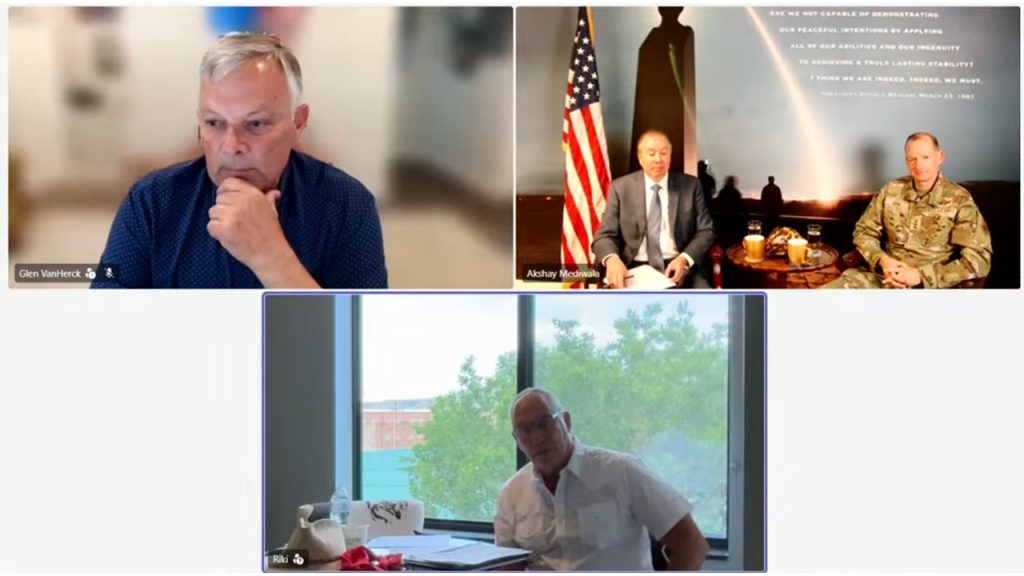
“From a great, wide-open country space day here in Rock Springs, Wyoming — I’m Riki Ellison, Chairman and Founder of the Missile Defense Advocacy Alliance.
We were founded 20-plus years ago, and we’ve been involved with missile defense for over 40 years. We have one singular purpose: to make our world and our nation safer through the advocacy, employment, and evolution of missile defense.
And there’s no time greater than today to advocate for and put in place missile defense capabilities around the world. Today marks our 103rd Congressional Roundtable, and we are very honored to have some of the greatest experts on this specific issue with us.
Thank you, Lieutenant General Christopher Niemi — the A5/7, the Deputy Chief of Staff and Chief Modernization Officer for the United States Air Force. Thank you for being here with us, General. We also have the former NORTHCOM/NORAD Commander, General Glen VanHerck, USAF joining us from Missouri. And we have Mr. John Rood, the former Under Secretary of Defense for Policy at the Department of Defense under President Trump in his first administration. This is a great group to push forward and to really illuminate, educate, and advocate for how we can get our bases better protected.
As an organization, we have visited over 841 bases over 20 years. The majority of those are U.S. Air Force bases; a majority of our Air Force bases are defended by U.S. Army missile defense systems. We support this movement that’s been put in place over the last 20 years, with our 16 Patriot battalions and our eight THAAD batteries that — predominantly, if not entirely, in their forward-operating mode — defending air bases.
We have just come back recently from Prince Sultan Air Base in Saudi Arabia, from air bases in Germany in Ramstein, from where we were in the Republic of Korea, from Guam, and from Hawaii. These air bases are a key part of global posture to project power and deterrence. They are extremely valuable in their ability to deter and in their ability to hold our allies together against the threat.
We’ve also known that our biggest allies defend their bases with their own air forces. Israel — their base defense is the Israeli Air Force. You can look at others: Japan, Korea for example. We do it a little differently — with the U.S. Army as the predominant defender of our air bases. And that’s appropriate, because the U.S. Army is built to defend land, to defend that aspect of it.
This decision goes back to 1948 and our division of roles and responsibilities, and I’m sure we’ll have some of that discussion today. But we’re at a point in time — Operational Epic Fury and Iran’s response to it highlighted that point. And, I could go back even further, probably to when Glen was in command, when we had drones flying over Langley Air Base. We have drones flying over our bases, and we come to the reality of Epic Fury and the destruction to U.S. and Allied assets which has happened.
We can’t deny it. It’s happened on our bases, and it’s been six months. We were just attacked on Sunday. We’ve got to find a solution and grapple with it — a tactical solution rapidly, and a strategic solution for the long term — because this is just a small example of our weak spot right now. For us to posture up and be able to deter China, we need to be capable of defending our bases, our air bases in the Pacific, everywhere.
This is the junction of how you do this better, how you make that change. The modernization of the Air Force, and the Air Force taking a leadership role in addressing this, is vitally important. We are just excited about the Chief, General Wilsbach (“Cruser”), taking the initiative, taking some responsibility on, and being able to do this. And we also know it’s going to be a capacity issue.
Even if the Air Force has this mission, you still need to have your allies, outside of the base defense, to be able to best defend assets. It’s a movement. I also want to recognize how well the U.S. Air Force has done with their F-15s and their ability to shoot down drones, which has considerably reduced the leakage — probably by 50% — by having them go air-to-air in those missions. We saw that in defending Israel last April.
We’re seeing this every day, if they get the opportunity to get those planes up — but that’s probably not the most efficient way to defend your base. And I don’t think the U.S. Air Force gets credit for what they’re doing with their manned air flights to take out these drones on top of that. I just want to push this over now and welcome General Niemi, who’s a good friend.”
– Riki Ellison’s Opening Remarks, 103rd MDAA Virtual CRT, 16 July, 2026
Speakers:
Lt. Gen. Christopher J. Niemi
Deputy Chief of Staff for Force Modernization; USAF Chief Modernization Officer
USAF Gen (Ret.) Glen VanHerck
(Ret.) Commander of NORAD and U.S Northern Command (USNORTHCOM); MDAA Board Member
Mr. John Rood
Former Under Secretary of Defense for Policy; MDAA Board Member
Mr. Riki Ellison
Founder & Chairman, MDAA
Click here to view the transcript
Click here to view the recording
Winners Associate with Winners to Win!